
For small businesses, warehouse efficiency directly impacts profitability. Slow picking times, disorganized inventory, and inefficient storage layouts can quickly lead to delayed shipments and rising labor costs. The good news? With the right strategy, businesses can optimize warehouse layout for faster order fulfillment without investing in expensive automation.
A well-designed warehouse layout improves speed, accuracy, and scalability — all critical for growing eCommerce fulfillment services and retail brands.
1. Position High-Volume SKUs Near Packing Stations
One of the most effective ways to improve speed is by placing best-selling or high-velocity products closest to packing and shipping areas.
When businesses optimize warehouse layout for faster order fulfillment, they reduce unnecessary walking time. Even shaving seconds off each pick adds up significantly across hundreds of daily orders.
Best practice tips:
-
Identify top 20% of SKUs generating 80% of sales
-
Store them in easily accessible zones
-
Re-evaluate SKU placement quarterly
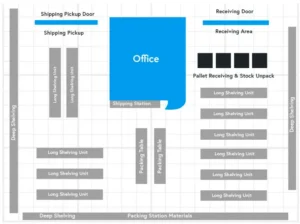
2. Create Logical Picking Zones
Zoning separates the warehouse into structured areas based on product type, size, or order frequency.
Instead of allowing pickers to move randomly throughout the facility, zoning creates defined pathways that increase efficiency and reduce congestion. This structured flow is essential when you want to optimize warehouse layout for faster order fulfillment in a growing operation.
Common zoning strategies include:
-
ABC inventory classification
-
Product category grouping
-
Temperature-controlled separation
-
Order batch picking zones
Clear zoning reduces errors and improves training efficiency for new staff.
3. Use Vertical Space Efficiently
Small businesses often overlook vertical storage potential. Shelving, bin systems, and mezzanine platforms allow warehouses to increase capacity without expanding square footage.
Maximizing vertical space helps businesses:
-
Reduce clutter
-
Improve SKU visibility
-
Maintain organized picking paths
When designed correctly, vertical systems make it easier to optimize warehouse layout for faster order fulfillment while keeping overhead costs low.
4. Implement Clear Aisle Markings and Labels
Warehouse layout optimization is not just about storage — it’s about navigation.
Clear signage, aisle numbers, and bin labels drastically reduce picking errors. Employees should never have to guess where an item is located.
Effective labeling systems include:
-
Barcode scanning
-
Color-coded shelf tags
-
Printed SKU location maps
-
Digital warehouse management systems (WMS)
These improvements reduce order errors and streamline workflow.
5. Reduce Travel Time with Smart Pick Paths
Travel time is one of the largest hidden costs in fulfillment operations.
Mapping optimized pick paths ensures employees move efficiently from one location to another. Many warehouses use WMS software to generate pick sequences automatically, but even manual route planning can significantly improve efficiency.
By minimizing unnecessary backtracking, small businesses can once again optimize warehouse layout for faster order fulfillment without adding labor costs.
6. Separate Receiving and Shipping Areas
Inbound and outbound traffic should not overlap.
When receiving docks compete with packing stations for space, congestion slows down productivity. Separating these areas improves safety and workflow continuity.
A clean separation between:
-
Receiving
-
Storage
-
Picking
-
Packing
-
Shipping
creates a smoother operational flow.
7. Regularly Audit and Adjust Layout
Warehouse layout should evolve alongside business growth.
As product lines expand and order volume increases, layout inefficiencies become more visible. Quarterly reviews allow businesses to:
-
Identify slow-moving inventory
-
Reassign high-velocity SKUs
-
Adjust shelving configurations
-
Improve workflow bottlenecks
Continuous improvement ensures the layout supports long-term scalability.
Why Warehouse Layout Optimization Matters for Small Businesses
For small businesses, every dollar and every minute counts. Labor costs, shipping speeds, and customer satisfaction are all directly influenced by layout efficiency.
When companies intentionally optimize warehouse layout for faster order fulfillment, they benefit from:
-
Faster shipping times
-
Lower labor costs
-
Improved picking accuracy
-
Higher customer satisfaction
-
Increased operational scalability
Layout optimization is one of the most cost-effective ways to improve fulfillment performance — without expensive robotics or automation systems.
Final Thoughts
Small businesses don’t need massive facilities to compete. What they need is smart organization and intentional design.
By improving SKU placement, zoning intelligently, using vertical storage, and mapping efficient pick paths, companies can optimize performance and prepare for growth.
If your business is looking to optimize warehouse layout for faster order fulfillment, start with small, strategic changes. The results compound quickly — and your customers will notice the difference.