
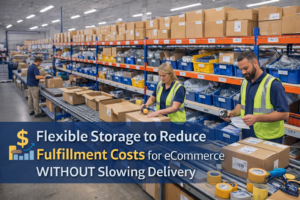
For eCommerce brands, fulfillment costs can quickly eat into profit margins. Storage fees, labor, shipping rates, and inefficiencies all add up — especially as order volume grows.
The challenge? Most businesses think reducing costs means sacrificing delivery speed.
That’s not true.
With the right strategy, you can reduce fulfillment costs for eCommerce without slowing delivery — and in many cases, actually improve both.
1. Use Flexible Storage Instead of Paying for Empty Space
One of the biggest hidden costs in fulfillment is unused warehouse space.
Many businesses are locked into pallet-based pricing models, meaning they pay for full pallets even when they’re only partially filled.
Switching to flexible storage (like bin or shared warehouse models) allows you to:
- Pay only for what you use
- Scale inventory up or down
- Avoid long-term storage commitments
This is one of the fastest ways to reduce fulfillment costs for eCommerce without slowing delivery.
2. Optimize Inventory Placement for Faster Picking
Where your inventory sits matters.
High-demand products should always be placed near packing stations to reduce picking time. Slow-moving SKUs can be stored further away.
This reduces:
- Labor time per order
- Employee fatigue
- Fulfillment delays
Strategic placement helps you reduce fulfillment costs for eCommerce without slowing delivery by improving operational efficiency.
3. Reduce Shipping Zones with Strategic Warehouse Location
Shipping distance is one of the biggest cost drivers.
If your inventory is stored far from your customers, you’ll pay more in shipping and experience slower delivery times.
By positioning inventory closer to key regions (like the Southeast), you:
- Lower carrier costs
- Shorten delivery times
- Improve customer satisfaction
Regional 3PLs are one of the most effective ways to reduce fulfillment costs for eCommerce without slowing delivery.
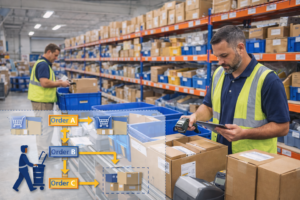
4. Batch Orders and Optimize Pick Paths
Many warehouses lose time simply due to inefficient movement.
Batch picking (picking multiple orders at once) and optimized pick paths reduce:
- Travel time
- Redundant movement
- Labor costs
Even small improvements here can significantly impact margins.
5. Minimize Returns with Better Accuracy
Returns are expensive.
Each incorrect order leads to:
- Return shipping costs
- Repacking labor
- Customer dissatisfaction
Improving picking accuracy through better organization, labeling, and systems reduces costly mistakes.
Less errors = lower cost per order.
6. Negotiate Better Shipping Rates Through a 3PL
Individual brands often don’t have the volume to secure discounted shipping rates.
3PL providers, however, ship at scale — which means they can negotiate significantly lower rates with carriers.
This allows your business to:
- Reduce per-package shipping cost
- Offer competitive shipping options
- Maintain fast delivery speeds
7. Automate Where It Makes Sense (Without Over-Investing)
Automation doesn’t have to mean robotics.
Simple tools like:
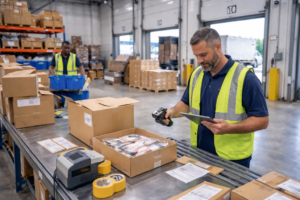
- Barcode scanners
- Inventory tracking systems
- Order management software
can dramatically improve efficiency without major investment.
The goal is to streamline operations — not overcomplicate them.
Why Cost Reduction and Speed Can Work Together
Many brands assume they must choose between:
- Lower costs
OR - Faster shipping
In reality, the most efficient fulfillment operations achieve both.
When you remove inefficiencies, improve layout, and use the right storage model, you naturally reduce costs and improve delivery speed.
Final Thoughts
If your fulfillment costs are rising, the solution isn’t to slow down — it’s to get smarter.
By improving storage efficiency, optimizing layout, reducing shipping zones, and leveraging 3PL advantages, you can reduce fulfillment costs for eCommerce without slowing delivery.
The brands that win in today’s market aren’t the ones spending the most — they’re the ones operating the smartest.