Scaling an eCommerce business is exciting but it comes with serious operational challenges. What works at 100 orders per month quickly breaks down at 1,000, and completely fails at 10,000.
Without the right systems in place, growth leads to:
- Shipping delays
- Inventory chaos
- Rising fulfillment costs
- Customer dissatisfaction
The good news? With the right strategy, you can scale eCommerce fulfillment from 100 to 10,000 orders per month efficiently without sacrificing speed or accuracy.
In this guide, we’ll walk through the exact steps to grow your fulfillment operation while maintaining control, profitability, and customer experience.

Stage 1: 100–500 Orders/Month (The Foundation Phase)
At this stage, most businesses are fulfilling orders in-house often from a home, garage, or small warehouse.
Key Focus Areas:
- Basic inventory organization
- Manual picking and packing
- Simple shipping workflows
Common Challenges:
- Disorganized inventory
- Slow picking times
- Lack of tracking systems
What You Should Do:
1. Implement Basic Inventory Structure
Use bins, labeled shelves, or SKU-based organization. Even simple systems reduce errors.
2. Standardize Packing Processes
Create a repeatable packing workflow to avoid inconsistencies.
3. Use Shipping Software
Tools like ShipStation or Pirate Ship streamline label creation and tracking.
At this level, your goal is not perfection it’s building a system that can scale.
Stage 2: 500–2,000 Orders/Month (The Optimization Phase)
As order volume grows, inefficiencies become more visible and more expensive.
Key Focus Areas:
- Warehouse layout optimization
- Picking efficiency
- Labor productivity
What Changes Here:
1. Optimize Warehouse Layout
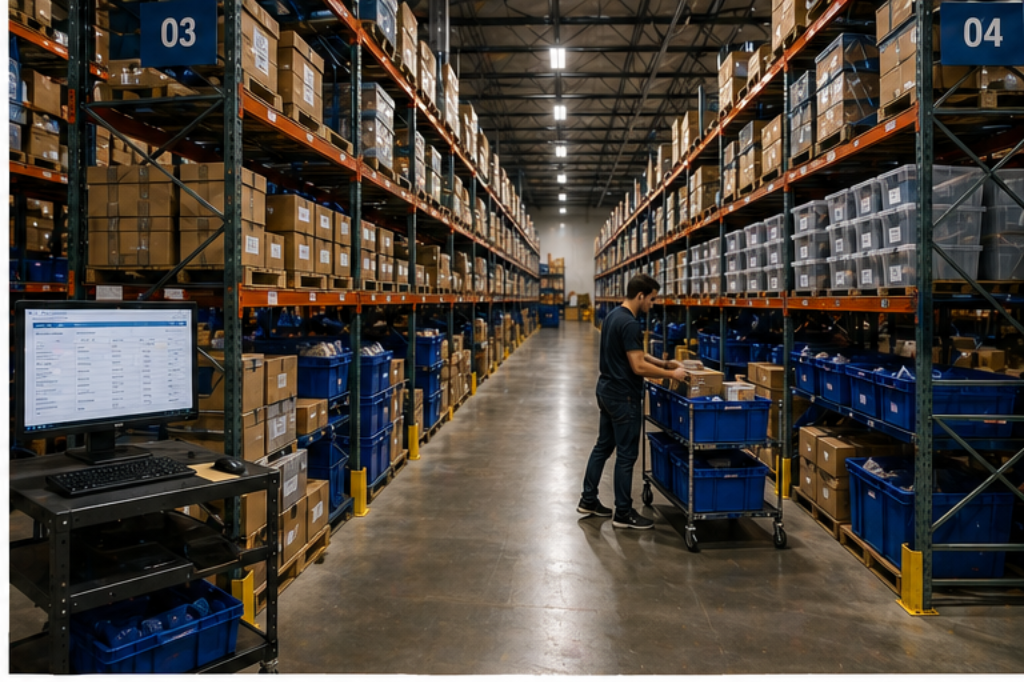
Place high-demand SKUs near packing stations. Reduce walking time it adds up fast.
2. Introduce Batch Picking
Instead of picking one order at a time, pick multiple orders in one trip.
3. Improve Labeling Systems
Clear bin labels, aisle markers, and SKU tracking reduce mistakes.
Common Mistakes at This Stage:
- Keeping the same layout from early growth
- Hiring more people instead of improving systems
- Ignoring workflow bottlenecks
To scale eCommerce fulfillment from 100 to 10,000 orders per month, this is where you must shift from “doing everything” to “building systems.”

Stage 3: 2,000–5,000 Orders/Month (The Scaling Phase)
At this stage, fulfillment becomes a serious operation.
Key Focus Areas:
- Process standardization
- Inventory accuracy
- Shipping cost control
What You Need to Implement:
1. Warehouse Management System (WMS)
A WMS gives you:
- Real-time inventory tracking
- Optimized pick paths
- Error reduction
2. Dedicated Picking Zones
Divide your warehouse into zones to improve speed and reduce congestion.
3. Inventory Forecasting
Running out of stock at this level can cost thousands in lost revenue.
4. Standard Operating Procedures (SOPs)
Every process should be documented:
- Picking
- Packing
- Returns
- Receiving
This is where operations either scale or collapse.