Unlocking the Benefits of 3PL Warehouses in Supply Chain Management

Unlocking supply chain success with 3PL

In today’s fast-moving, customer-driven economy, supply chain efficiency is no longer a back-office concern—it’s a competitive advantage. Businesses are expected to deliver faster, cheaper, and more reliably than ever before, all while navigating fluctuating demand, rising labor costs, and global disruptions. For many companies, especially those scaling operations or managing complex distribution networks, this is where Third-Party Logistics (3PL) warehouses step in as a game-changing solution.

A 3PL warehouse is more than just outsourced storage. It’s a strategic extension of your business that can transform how products move from manufacturer to customer. When implemented correctly, 3PL partnerships unlock flexibility, reduce costs, improve service levels, and allow companies to focus on what they do best.

This article explores what 3PL warehouses are, how they fit into modern supply chain management, and—most importantly—the tangible benefits they provide to businesses across industries.

What Is a 3PL Warehouse?

A Third-Party Logistics (3PL) warehouse is a facility operated by an external logistics provider that manages warehousing, fulfillment, and distribution services on behalf of another business. Instead of owning or leasing warehouse space and managing staff, equipment, and technology internally, companies outsource these functions to a specialized partner.

Typical 3PL warehouse services include:

  • Inventory storage and management

  • Order fulfillment (pick, pack, ship)

  • Transportation coordination

  • Returns processing (reverse logistics)

  • Value-added services (kitting, labeling, assembly)

Unlike traditional warehouses, modern 3PL facilities are technology-driven hubs designed to integrate seamlessly with a company’s supply chain systems, offering real-time visibility and scalability.

The Role of 3PL Warehouses in Modern Supply Chains

Supply chains today are dynamic ecosystems rather than linear pipelines. Products may originate from multiple suppliers, pass through various distribution points, and end up in diverse sales channels such as eCommerce platforms, retail stores, and marketplaces.

3PL warehouses play a central role in this ecosystem by acting as operational connectors. They bridge the gap between production, transportation, and final delivery. By leveraging advanced warehouse management systems (WMS), automation, and carrier networks, 3PLs synchronize inventory flow and optimize order processing.

This integration allows businesses to respond faster to market changes, reduce bottlenecks, and maintain consistent service levels—even during periods of volatility.

Key Benefits of 3PL Warehouses

1. Cost Efficiency and Reduced Overhead

One of the most compelling reasons companies turn to 3PL warehouses is cost savings. Operating a warehouse in-house requires significant capital investment, including:

  • Facility leasing or ownership

  • Labor recruitment and training

  • Equipment and automation

  • Software and IT infrastructure

With a 3PL, these costs are shared across multiple clients. Businesses pay only for the space and services they use, converting fixed costs into variable expenses. This model is especially attractive for startups, seasonal businesses, and companies experiencing rapid growth.

Additionally, 3PLs benefit from economies of scale, often securing lower shipping rates and operational efficiencies that individual companies cannot achieve alone.

2. Scalability and Flexibility

Demand fluctuations are a reality in nearly every industry. Seasonal spikes, promotional campaigns, and market shifts can quickly overwhelm internal logistics operations.

3PL warehouses are designed for scalability. They can:

  • Expand storage space during peak seasons

  • Increase labor capacity on short notice

  • Adjust fulfillment volume without long-term commitments

This flexibility allows businesses to grow—or contract—without the risk and expense of underutilized warehouse space. Whether you’re launching a new product or entering a new market, a 3PL can adapt alongside your business.
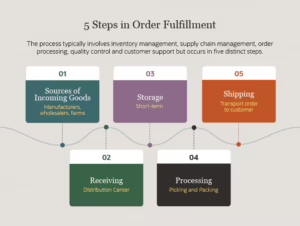
Faster Order Fulfillment and Improved Customer Experience

3. Faster Order Fulfillment and Improved Customer Experience

In the age of same-day and next-day delivery, speed matters. Customers expect fast, accurate, and transparent shipping—and they won’t hesitate to switch brands if expectations aren’t met.

3PL warehouses enhance fulfillment speed by:

  • Positioning inventory closer to end customers

  • Utilizing optimized pick-and-pack workflows

  • Integrating with multiple carriers for faster transit times

Many 3PLs operate strategically located distribution centers, enabling businesses to reduce shipping zones and delivery times. The result is improved customer satisfaction, fewer shipping complaints, and stronger brand loyalty.

4. Access to Advanced Technology

Warehouse technology is evolving rapidly, from barcode scanning and RFID tracking to AI-driven demand forecasting. Building and maintaining this technology in-house can be expensive and complex.

3PL providers invest heavily in cutting-edge systems, including:

  • Warehouse Management Systems (WMS)

  • Inventory tracking and analytics dashboards

  • Automated picking and sorting tools

  • API integrations with eCommerce and ERP platforms

By partnering with a 3PL, businesses gain access to enterprise-level logistics technology without the upfront investment, ensuring greater accuracy, transparency, and operational control.

5. Focus on Core Business Activities

Managing logistics internally can drain time, energy, and resources from strategic initiatives like product development, marketing, and customer engagement.

Outsourcing warehousing allows businesses to:

  • Reduce operational complexity

  • Free leadership teams from logistics management

  • Allocate resources to growth-driven activities

In essence, 3PL warehouses enable companies to focus on what they do best, while logistics experts handle the backend operations.

6. Risk Mitigation and Business Continuity

Supply chains are vulnerable to disruptions—from labor shortages and equipment failures to natural disasters and global events. A single point of failure in warehousing can halt operations entirely.

3PL providers mitigate risk by:

  • Operating multiple facilities across regions

  • Maintaining backup systems and contingency plans

  • Offering flexible rerouting and inventory redistribution

This redundancy improves business continuity and reduces the impact of unforeseen disruptions.

7. Expertise and Industry Knowledge

Logistics is a specialized discipline requiring deep operational expertise. 3PL providers employ professionals with experience across industries, regulations, and transportation modes.

This expertise translates into:

  • Optimized warehouse layouts

  • Compliance with shipping and safety regulations

  • Efficient returns and reverse logistics processes

By leveraging this knowledge, businesses can avoid costly mistakes and continuously improve supply chain performance.

3PL Warehouses Across Different Industries

3PL warehouses are not one-size-fits-all. They serve a wide range of industries, each with unique requirements:

  • eCommerce: Fast fulfillment, returns handling, marketplace integrations

  • Retail: Store replenishment, cross-docking, seasonal inventory management

  • Manufacturing: Raw material storage, just-in-time distribution

  • Healthcare: Temperature-controlled storage, compliance tracking

  • Food & Beverage: Lot tracking, expiration management, cold storage

This adaptability makes 3PLs a versatile solution for businesses of all sizes and sectors.

Choosing the Right 3PL Warehouse Partner

While the benefits are substantial, selecting the right 3PL partner is critical. Key factors to evaluate include:

  • Facility locations and network coverage

  • Technology compatibility with your systems

  • Service level agreements (SLAs) and performance metrics

  • Experience in your industry

  • Transparency in pricing and reporting

A successful 3PL relationship is built on collaboration, communication, and aligned goals—not just cost savings.

The Future of 3PL Warehouses in Supply Chain Management

As supply chains become more data-driven and customer-centric, the role of 3PL warehouses will continue to expand. Emerging trends include:

  • Increased automation and robotics

  • AI-powered demand forecasting

  • Sustainable warehousing practices

  • Omnichannel fulfillment integration

Rather than being a tactical outsourcing decision, 3PL partnerships are evolving into long-term strategic alliances that shape how businesses compete in the global marketplace.

Conclusion

3PL warehouses have become an essential pillar of modern supply chain management. By offering cost efficiency, scalability, advanced technology, and operational expertise, they empower businesses to navigate complexity with confidence.

Whether you’re a growing eCommerce brand, a manufacturer optimizing distribution, or a retailer expanding reach, leveraging a 3PL warehouse can unlock new levels of efficiency and resilience. In an increasingly competitive environment, the question is no longer whether to use a 3PL—but how to use one strategically.

By choosing the right partner and integrating logistics into your broader business strategy, 3PL warehouses can transform your supply chain from a cost center into a powerful growth engine.